
If you are investing in digital advertising, or planning to scale your campaigns across multiple channels, you have probably come across the term DSP.
But what does it actually mean, and why should you care?
What is a DSP?
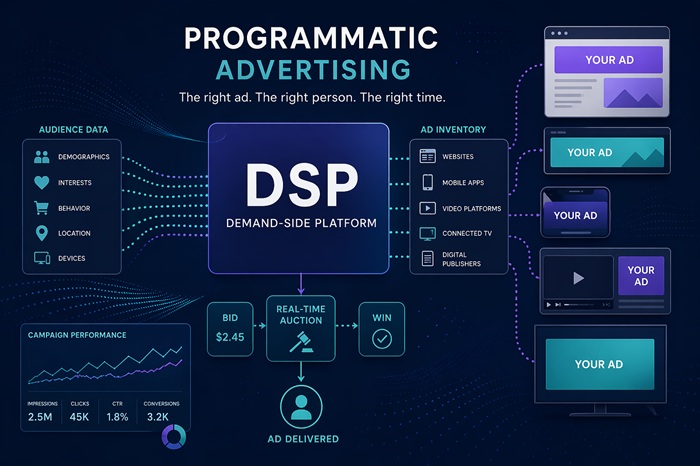
A DSP (Demand-Side Platform) is a tool that allows brands and advertisers to buy digital advertising space automatically, across thousands of websites, apps and video platforms.
Instead of negotiating placements manually with each media outlet, a DSP gives you access to a massive amount of inventory in one place, and lets you decide:
- Who you want to reach
- How much you want to pay
- Where your ads appear
All of this happens in real time.
How does it work?
Behind the scenes, programmatic advertising works through automated auctions.
Every time a user loads a webpage or opens an app:
- An ad impression becomes available
- Advertisers compete for that impression in real time
- Your DSP decides if that user fits your target audience
- If it does, it places a bid
- If you win, your ad is shown
This entire process takes place in milliseconds.
Why does this matter for your brand?
From a marketing perspective, a DSP is not just a tool, it is a way to scale and optimise your media buying.
It allows you to:
- Reach your audience across multiple websites and platforms
- Use data to target specific user profiles
- Optimise campaigns based on performance
- Control budgets and bidding strategies
- Access formats like display, video, mobile and connected TV
In short, it moves you from manual media buying to data-driven, automated decision making.
DSP vs traditional media buying
Traditionally, brands would negotiate directly with media outlets, agree on fixed placements, and pay a predefined price.
With a DSP:
- buying is dynamic, not fixed
- pricing is based on auctions, not negotiations
- targeting is audience-based, not just placement-based
- optimisation happens continuously, not after the campaign
This makes campaigns more flexible, but also more complex if not managed properly.
Where DSP fits in the ecosystem
To understand the full picture, it helps to know that DSPs are just one side of the programmatic ecosystem.
- DSP: used by advertisers to buy inventory
- SSP (Supply-Side Platform): used by publishers to sell inventory
Both sides connect through ad exchanges, where auctions happen.
Examples of DSP platforms
Some of the most widely used DSPs include:
- Google Display & Video 360
- The Trade Desk
- Amazon DSP
Each one offers different capabilities depending on your markets, budgets and objectives.
Is a DSP always the best option?
Not necessarily.
While DSPs are powerful, they are not always the best solution in every scenario.
In some markets, especially in regulated industries like online gambling, direct deals with media or local partnerships can still play a key role.
The right approach often combines:
- Programmatic buying (via DSP)
- Direct media deals
- Local market knowledge
That´s where a specialised iGaming marketing agency can play a key role.
Final thoughts
A DSP is essentially a tool that helps you buy the right impression, for the right user, at the right time, automatically.
But the real value does not come from the tool itself.
It comes from:
- Having a clear strategy
- Defining the right audience
- Setting the right priorities
- And making smart decisions based on data
That is where most campaigns succeed or fail.
Looking for marketing campaigns in Chile, Spain or other LATAM markets?
At Itzitip, we work with trusted local agencies across Chile, Spain and other Latin American markets to help brands plan and execute effective marketing campaigns.
We support digital strategies including DSP and programmatic advertising, as well as local TV, digital media buying, influencers and other market-specific initiatives.
The focus is always the same, combining local expertise with a structured approach to deliver campaigns that actually move the needle.