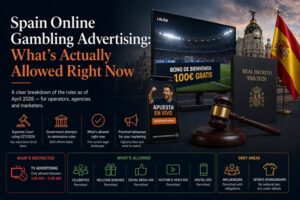
This post is a clear breakdown of the legal landscape of the Spanish Online Gambling Advertising regulation, including the decree that reshaped the market, the Supreme Court ruling that dismantled it, and where things actually stand today.
Why this post exists: Spain’s gambling advertising rules have been through a legal storm. A strict decree in 2020, a landmark Supreme Court ruling in 2024 that killed key parts of it, then a government attempt to bring them back — which also failed.
If you’re an operator, an agency, or anyone planning marketing in the Spanish market, this is the clearest summary we can give you of where things stand.
We’ll update it as the regulation evolves.
The starting point: RD 958/2020 (The “Garzón Law”)
In November 2020, the Spanish government passed Royal Decree 958/2020 on commercial communications for gambling activities — quickly nicknamed the Ley Garzón after the Minister of Consumer Affairs who championed it.
It was one of the most restrictive gambling advertising frameworks in Europe. The headline measures:
- TV: blackout hours. Gambling ads could only air between 1:00am and 5:00am. Gone was the exception that had allowed ads during live sports broadcasts.
- No celebrities. No person or character of public relevance — real or fictional — could appear in gambling ads.
- No welcome bonuses. Promotional offers to attract new players were banned outright.
- Online and social media severely restricted. Digital advertising could only target existing customers, not new ones. Social media campaigns for acquisition: prohibited.
The law had a phased rollout. By mid-2021 it was fully in force. For several years, operators had to live with these constraints — no influencer deals, no celebrity faces, no acquisition campaigns on Instagram or YouTube.
The earthquake: Supreme Court ruling 527/2024
On 2 April 2024, Spain’s Supreme Court (Sala de lo Contencioso-Administrativo) handed down a landmark ruling on a challenge brought by Jdigital — the Spanish Digital Gaming Association — and partially struck down RD 958/2020.
What the Court killed
The Court ruled that several key articles lacked sufficient legal basis — they went beyond what a Royal Decree can legitimately regulate without parliamentary backing. The articles annulled were:
- Art. 13.1 & 13.3 — Ban on promotional offers for new customers (welcome bonuses, acquisition campaigns): annulled.
- Art. 15 — Prohibition on public figures and celebrities appearing in gambling ads: annulled.
- Art. 23.1 — General ban on digital advertising across information society services: annulled.
- Art. 25.3 — Restrictions on video platform advertising (YouTube, etc.): annulled.
- Art. 26.2 & 26.3 — Limits on social media advertising: annulled.
The Court’s reasoning was clear: advertising is an expression of freedom of enterprise (Article 38 of the Spanish Constitution). Blanket restrictions affecting an entire medium cannot be established by regulation alone — they require specific parliamentary authority. The decree had overstepped.
What survived
Not everything fell. The TV advertising blackout (1:00am–5:00am only) was upheld, along with other content restrictions that did have proper legal grounding. The ruling was a partial win for the industry, not a full liberalisation.
The Government strikes back — and fails (Twice)
The government’s response was predictable: if a Royal Decree lacks legal standing, pass a law. Two attempts were made to reintroduce the restrictions with proper parliamentary authority.
Attempt 1: Public Health Agency Bill — 2024
The government tried to slip a gambling advertising amendment into the bill creating the State Public Health Agency. It was rejected at the parliamentary stage.
Attempt 2: Amendment 176 to the Customer Services Bill — May 2025
The government introduced Amendment 176 into the Customer Services Act (Ley de Atención a la Clientela) — a completely unrelated piece of legislation. The amendment proposed reinstating all the annulled restrictions and adding new ones: banning celebrities, restricting social media acquisition, and prohibiting email marketing without prior consent.
The industry called it an “enmienda intrusa” — an intruder amendment.
The Customer Services Bill passes — without the gambling amendment (December 2025)
The Senate (with a PP majority) struck out the gambling provisions, deeming them unrelated to the bill’s subject matter.
When it returned to Congress on 11 December 2025, the government lacked the votes to restore them — partly due to the fragile parliamentary position after Junts stopped supporting the coalition.
The gambling amendment fell. The Customer Services Act (Ley 10/2025) was published in the BOE on 27 December 2025, with no gambling advertising changes.
The current regulatory picture — 2026
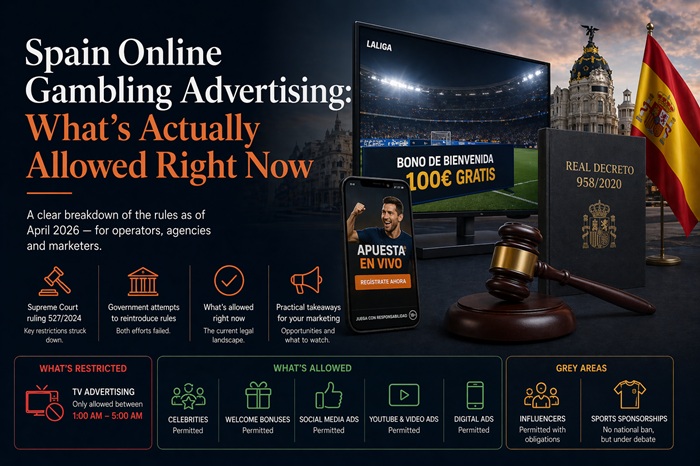
This is the state of play right now. We’ve kept this as a simple reference table:
| Area | Status | Notes |
|---|---|---|
| TV advertising | Restricted | Only permitted between 1:00am – 5:00am. This rule was not annulled and remains in force. |
| Celebrity endorsements | Permitted | Art. 15 was annulled by the Supreme Court. Public figures can appear in gambling ads again. |
| Welcome bonuses & new player promos | Permitted | The acquisition ban was annulled. Operators can freely offer and advertise welcome offers. |
| Social media advertising | Permitted | Including campaigns targeting potential new customers — annulled by the Court. |
| Video platform advertising (YouTube, etc.) | Permitted | Art. 25.3 was annulled. Operators can run pre-roll and display campaigns on streaming platforms. |
| Digital advertising (general) | Permitted | The general ban on information society services advertising was annulled. |
| Influencer / content creator marketing | Grey area | Permitted in principle, but subject to new 2025 obligations: visible risk warnings required, operators co-responsible for compliance. |
| Sports sponsorships | Grey area | No national ban currently in force, but under debate regionally (e.g. Castilla y León consultation). Monitor closely. |
| Email / postal marketing | Grey area | Governed by GDPR/LOPD (consent required). The specific gambling ban failed, but general data protection rules apply. |
What to watch: this ssn’t over
The current government has made restricting gambling advertising a clear policy priority. With the parliamentary arithmetic currently unfavourable (the coalition lost Junts’ support), a new legislative push is unlikely in the near term — but not impossible.
A few things to monitor:
- Any new parliamentary initiative — the government has shown it will use any available legislative vehicle to try again.
- Regional regulations — Spain’s autonomous communities can and do pass their own gambling-adjacent rules, especially around sports sponsorships and proximity to schools. Castilla y León and others have active consultations.
- EU harmonisation — the European Commission is pushing for shared data and standards across member states. This could lift the floor on Spanish regulations over time.
- DGOJ enforcement — the regulator continues to enforce what remains in force vigorously. Don’t assume the looser environment means looser compliance.
Practical implications for Operators
If you’re planning marketing investment in Spain — whether as an operator, an agency, or a platform — the key takeaways are:
The digital channel is open. Social, display, programmatic, influencer, video platforms — all available again. The years of restriction ended with the Supreme Court ruling and the government has not been able to reverse it.
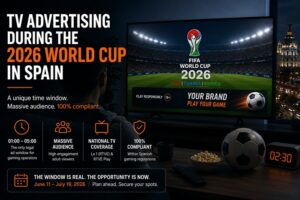
TV is actually a unique opportunity. The 1am–5am window is the only slot available — but it’s not dead air. Spanish late-night programming regularly features sports recap shows, football analysis programmes, and live coverage of international competitions across time zones. For sportsbooks especially, this is a highly targeted audience: engaged, sports-savvy, and actively thinking about odds. It’s a niche — but it’s your niche.
Responsible gambling compliance is non-negotiable and getting stricter. Since 2025, operators must implement early-detection algorithms for problematic behaviour. Influencer and creator partnerships require visible risk disclosures, and operators are co-responsible. This is an area of active regulatory development.
Sports sponsorships are a risk you can take — but monitor it. There’s no national ban, but the political pressure exists and regional restrictions are being debated.
Planning marketing in Spain or LatAm?
At itzitip we work as an Online Gambling consultancy in Spain. We work with operators and agencies navigating complex gambling markets, from regulatory strategy to local partner networks and all marketing services for iGaming operators.
If you need a clear picture of what’s possible and who can execute it, let’s talk.
Let´s have a call and discuss how we can help your brand